Callum's Transformation and Adoption into the Vampire Royal Family
The Secret VampireCallum's Transformation and Adoption into the Vampire Royal Family is the origin event that turns an unknown young man fleeing the violence of Cape Town into Callum, the son and intended legacy of Vampire King Vlad and Queen Carmilla. The transformation does more than introduce a supernatural protagonist: it places a former human inside the ruling vampire dynasty, creates the emotional conflict between inherited vampiric power and remembered humanity, and makes Callum's later attempts to restrain violence and pursue coexistence part of a struggle over what the royal family should become.
War, Pursuit, and the Unknown Stranger
The event begins against the Human–Vampire War of Cape Town, a conflict that has made the town a place of fear and bloodshed. Ten years earlier, Vampires controlled the town under their king and queen, while humans were afraid to leave their homes at night because Vampires could kill or feed on them. The human mayor declared war, and the first attacks failed because the Vampires were faster and more powerful. Human forces then turned to garlic bombs and holy water, weapons associated with the established vulnerabilities of Vampires.
The war eventually shifts when humans use a giant garlic bomb aimed at the sky together with holy water. Many Vampires die or retreat, and the humans begin to sense victory. The change in the weather from stormy rain to sunshine accompanies their expectation that the Vampire King will be forced into a peace agreement, including the rule of No hunting and no biting. Amid that military reversal, a young man runs through the chaos while being pursued by a fast, unknown spirit. He slips, strikes his head, briefly opens his eyes, and loses consciousness. His identity, the reason for his flight, and the nature of his pursuer are initially withheld, giving his transformation the shape of both a supernatural rescue and a mystery.
Death, Awakening, and Naming
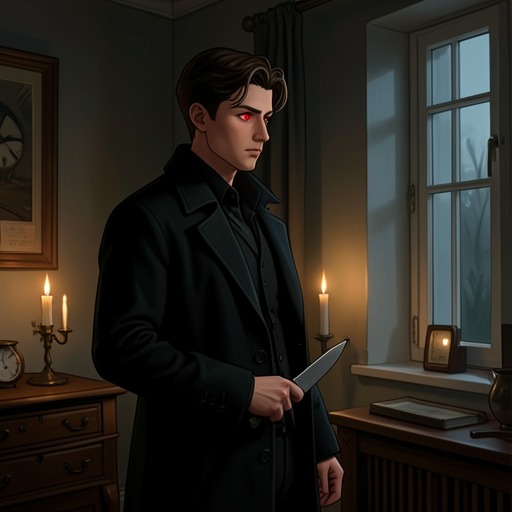
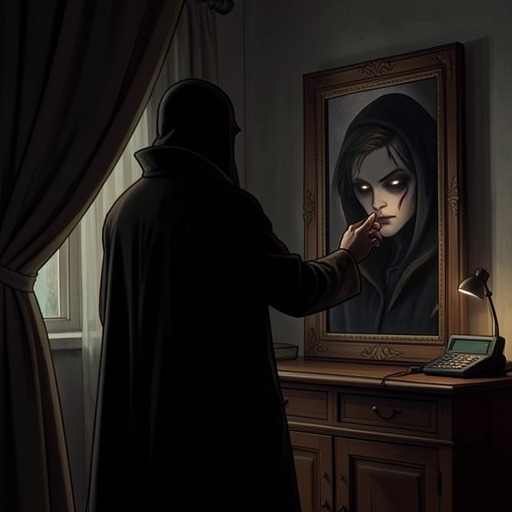
When the young man awakens, he finds himself in a room decorated in an old-fashioned style. He tries to look at his reflection in a mirror but sees none, an immediate physical sign that his identity has changed before he understands how. The curtains are drawn, and he cannot remember what happened. A voice summons him downstairs, where he encounters a crowned, heavily pregnant woman and a man who appears more than one hundred years old without showing physical age.
The older man identifies himself as Vlad, the Vampire King, and identifies the woman as Carmilla, his wife. When the stranger asks why he is there, Vlad tells him that he is dead and that he will become their son and their legacy. The declaration supplies the event's central contradiction: Callum's former life is ended without being explained, yet his new life is immediately assigned a political and familial purpose. He is not merely converted into a Vampire; he is absorbed into the ruling house and given a place within its succession.
Carmilla goes into labor while the unidentified young man remains present. The doctor delivers a girl, but Carmilla dies in childbirth. Her death produces the crisis through which Callum's new nature becomes visible. The newborn opens her eyes and reveals red eyes, while Vlad mourns Carmilla and then bites her neck. When the human doctor realizes that the household consists of Vampires and attempts to flee, Vlad orders Callum to get her. Callum corners the doctor and drains her after biting her heavily. The transformation is therefore marked by immediate participation in royal violence: the newly adopted son is made an instrument of the family's secrecy before he has even received his name.
Vlad names the young man Callum. As Callum wipes blood from his mouth, Vlad orders a servant to dispose of the doctor's body and calls the newborn their little princess while presenting Callum as their prince. Callum's eyes change from blue to red, completing the visible passage from human stranger to Vampire royal. The sequence joins biological signs, violent initiation, and ceremonial naming: red eyes identify the new species, blood confirms the new appetite, and the name gives the former unknown figure a stable place in the dynasty.
Adoption, Legacy, and Divided Identity
Callum's adoption is defined by Vlad's insistence that he will be their son and legacy, while the newly born girl becomes his princess sister. Carmilla's death prevents the adoption from becoming a simple domestic welcome; Callum enters the family at the same moment that the family loses its queen. He is consequently linked to both succession and mourning from the beginning. His new status offers protection and authority, but it also binds him to the royal household's long-standing relationship with human blood.
The later plot repeatedly returns to the tension created by this origin. During his duel with Vlad, Callum rejects continued feeding on humans and demands more than a verbal promise. He presents a contract requiring Vlad's signature and argues that humans and Vampires can coexist peacefully. Vlad signs, agreeing not to feed on humans. Callum's demand shows how far the adopted prince's identity has developed beyond the violent circumstances of his entrance into the royal family: the former human memory within him becomes the basis for challenging the king's customary practice and converting a personal conviction into a binding royal commitment.
Callum also explicitly remembers that he was once human. When he worries that Carmilla might love him less because he opposed feeding on humans and won the duel with Vlad, she assures him that she loves him and Elise equally. Her response confirms that Callum's adoption is emotionally real within the family even though his entry was supernatural and politically useful. The relationship gives him a maternal bond that is not erased by his transformed body, while his question reveals the insecurity produced by belonging to a family whose species and traditions he did not originally share.
Consequences for the Wider Story
The transformation establishes the contrast between Callum's royal Vampire identity and the human identity of Celeste Rodriguez, whose life becomes central to his later choices. Celeste eventually learns that Vampires are real after a disturbing dream in which Callum appears as a Vampire. Isabelle gives her a wooden stake and explains that Vampires die when staked through the heart, turning Callum's secret nature into a direct threat within Celeste's understanding of the world. The origin event thus creates the hidden difference around which their relationship develops: Callum belongs to the ruling supernatural order, while Celeste approaches that order from the human side.
Callum's adoption also explains why his later actions carry consequences beyond private romance. As a member of the royal family, he is implicated in the danger created when Susie Rodriguez is transformed and begins killing people. He identifies himself to Susie as a Vampire and warns that her killings place the Vampires at risk. His intervention reflects the double responsibility created by his adoption: he must manage the violence of his own kind while protecting the secrecy and survival of the kingdom.
The event's most important reversal occurs when Callum's royal identity becomes entangled with grief and accusation. After Susie kills Carmilla, Callum believes Celeste is responsible and attacks her in the hospital, threatening to make her feel death. The adopted son who once received a place in Carmilla's family becomes the person seeking revenge for her death. Yet the later revelation that Samara murdered Carmilla restores the distinction between Callum's grief and the truth of the crime. His transformation therefore supplies both the emotional origin of his loyalty to the royal family and the wound that temporarily turns that loyalty against Celeste.
Narrative Significance and Long-Term Arc
As a plot structure, Callum's transformation combines metamorphosis, adoption, and ascension. A nameless figure crosses from the battlefield into the castle, dies as an apparent human, awakens without a reflection, receives a royal name, and is presented as a prince. The movement is not a gradual coming-of-age but a forced passage into a new social and bodily order. Its mystery is initially carried by the unanswered questions surrounding the pursuer and the young man's past; its resolution comes through the royal family's declaration that death has already occurred and that a new identity will replace it.
The event also creates a productive contradiction between label and conduct. Callum is marked as a Vampire prince through red eyes, blood-drinking, and royal adoption, yet he later uses that position to demand No hunting and no biting and to advocate peaceful coexistence between humans and Vampires. His identity is therefore not reduced to the label imposed on him. The story repeatedly places the terms human, Vampire, monster, prince, and son in tension, allowing Callum's actions to revise what each designation means.
By the end of the narrative, Callum's origin has become the foundation for a different kind of inheritance. He remains tied to Vlad, Carmilla, and Elise as a member of the royal family, but his decisive legacy is not simply continuation of the old order. His contract with Vlad, his protection of Celeste, and his eventual engagement to her connect the transformed human with the possibility of human–Vampire coexistence. The stranger who was once carried into the castle by death becomes the prince who tries to make the two worlds live under a new rule.